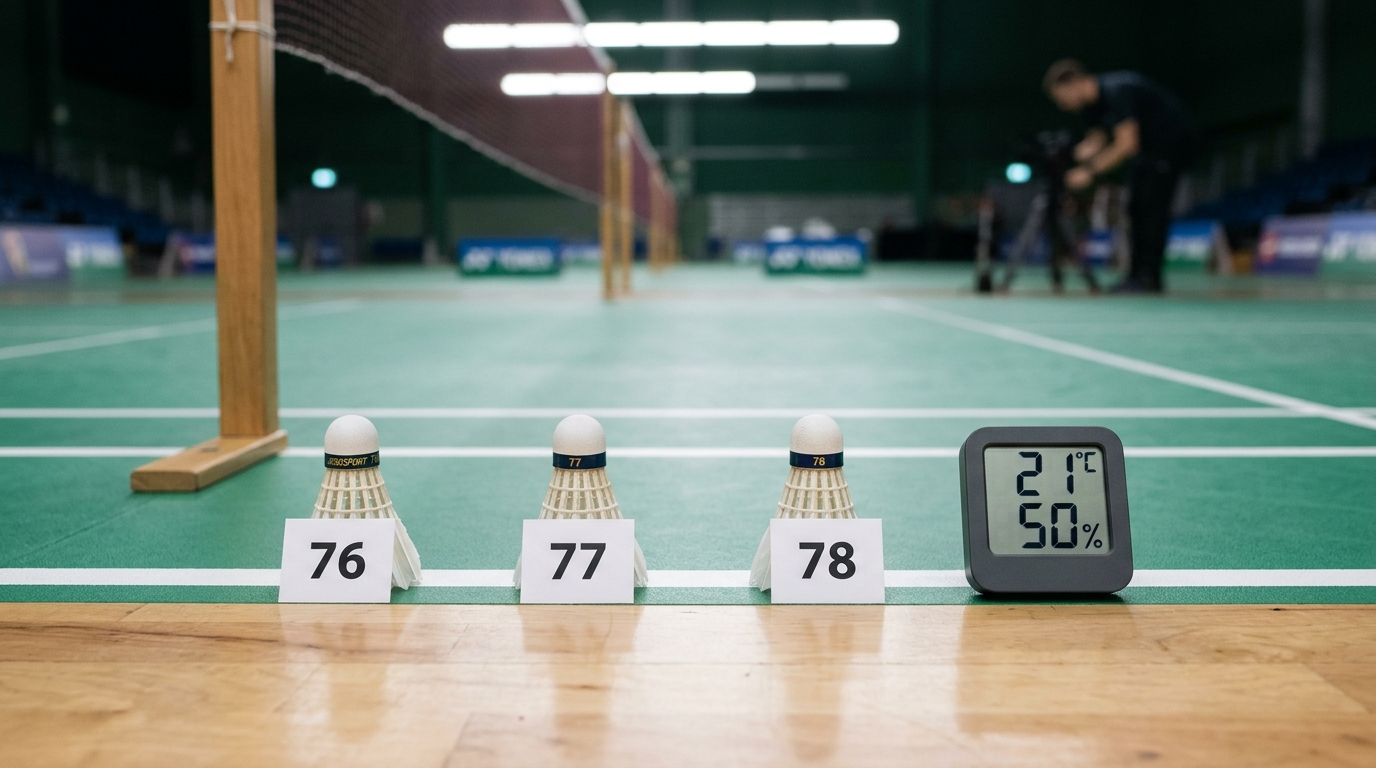
Few things ruin a competitive badminton match faster than a shuttlecock flying at the wrong speed. A shuttle that is just one speed grade too fast sails effortlessly over the baseline on standard clears, forcing players to throttle their power and distort their mechanics. Conversely, a shuttle that is too slow requires exhausting shoulder torque to reach the rearcourt and turns offensive smashes into sluggish floaters.
⚡ QUICK SELECTION RULE: TEMPERATURE VS SPEED
- Hot Summer Halls (> 25°C / > 77°F): Buy Speed 76 (or Speed 2 / Green Cap). Air is thin; shuttles naturally fly faster.
- Standard Moderate Halls (19°C – 24°C / 66°F – 75°F): Buy Speed 77 (or Speed 3 / Blue Cap). The international benchmark speed.
- Cold Winter Halls (< 18°C / < 64°F): Buy Speed 78 (or Speed 4 / Red Cap). Cold dense air slows the shuttle; heavier weight maintains depth.
- High Altitude (> 1,000 meters / 3,300 ft): Drop 1 to 2 speed grades lower (e.g., switch from 77 to 76 or 75) to compensate for low atmospheric pressure.
BWF Official Shuttlecock Speed & Temperature Matrix
Shuttlecock manufacturers calibrate speeds by feather weight and quill density. The number (e.g., 76, 77, 78) historically represented the shuttlecock weight measured in traditional English grains (1 grain ≈ 0.0648 grams). Today, it corresponds to strict metric weight brackets and temperature thresholds established by the Badminton World Federation (BWF):
| Speed Rating | Alternative Code | Calibrated Hall Temp | Target Weight (Grams) | Flight Characteristic | Recommended Environment | Check Price |
|---|---|---|---|---|---|---|
| Speed 75 | Speed 1 / Slow | > 30°C (> 86°F) | 4.74 – 4.77 g | Ultra-Light / Slowest | Tropical summer halls or high-altitude cities (> 1,200m) | Check Price → |
| Speed 76 | Speed 2 / Medium-Slow | 25°C – 30°C (77°F – 86°F) | 4.80 – 4.87 g | Controlled / Mild Drag | Warm unairconditioned halls, summer league sessions | Check Price → |
| Speed 77 | Speed 3 / Medium | 19°C – 24°C (66°F – 75°F) | 4.93 – 5.00 g | Optimal BWF Standard | Standard climate-controlled sports arenas, spring/autumn | Check Price → |
| Speed 78 | Speed 4 / Medium-Fast | 14°C – 19°C (57°F – 66°F) | 5.05 – 5.12 g | Fast / Punchy Depth | Cold winter halls, northern climates without central heating | Check Price → |
| Speed 79 | Speed 5 / Fast | < 14°C (< 57°F) | 5.18 – 5.25 g | Heaviest / Maximum Punch | Freezing unheated sports barns, sub-zero outdoor climates | Check Price → |
The Atmospheric Physics: Why Temperature Dictates Shuttle Speed
Unlike tennis balls or squash balls which bounce off rigid surfaces, a badminton shuttlecock is an open conical aerodynamic decelerator. When a smash leaves the racket at 400+ km/h (250 mph), aerodynamic drag forces immediately begin dissipating kinetic energy, reducing speed to under 60 km/h by the time it reaches the opposing baseline.
According to fluid dynamics, aerodynamic drag force ($F_D$) is directly proportional to air density ($\rho$):
F_D = 0.5 × ρ × v² × C_D × A
Where ρ is the air density, v is velocity, C_D is the drag coefficient of the feathered skirt, and A is the frontal cross-sectional area (approx. 65-68mm skirt diameter).
When an indoor gym heats up from 15°C to 28°C during a summer afternoon, the thermal expansion of air molecules causes air density (ρ) to drop by nearly 5%. Because the air offers significantly less resistance, the exact same shuttlecock struck with identical force will travel 30 to 50 cm (12 to 20 inches) further. If you are already hitting deep clears to the tramlines, that 5% drop in air density turns every baseline clear into an out call.
Conversely, in winter, air becomes dense and sluggish. A standard Speed 77 shuttlecock will feel heavy, requiring excessive arm effort and falling a foot short of the baseline. By switching to a Speed 78 (which is manufactured slightly heavier by adding microscopic weight to the cork or selecting denser feather shafts), the shuttlecock’s added momentum counteracts the dense air resistance, restoring normal baseline depth.
The Altitude Factor: Playing Above Sea Level
Altitude has a dramatic effect on shuttlecock speed that catches traveling tournament players completely off guard. As altitude increases, atmospheric barometric pressure drops exponentially:
- Sea Level (0 to 300 meters / 0 – 1,000 ft): Standard speed applies (Speed 77 is default for moderate climates).
- Moderate Elevation (500 to 1,000 meters / 1,600 – 3,300 ft): Drop 1 speed grade (use Speed 76 instead of 77).
- High Elevation (> 1,200 meters / > 4,000 ft, e.g., Denver, Calgary, Mexico City, Kunming): Drop 2 full speed grades (use Speed 75 or special altitude-rated shuttles). In these cities, standard Speed 77 shuttles are virtually unplayable without modification.
How to Test Shuttlecock Speed on the Court (BWF Official Procedure)
Before any sanctioned BWF tournament or competitive club league match, players and tournament officials conduct a formal speed test. You can perform this test in your local hall in less than two minutes:
The 4-Step BWF Testing Protocol
- Position: Stand directly on the rear back boundary line of the court.
- Stroke: Hit the shuttlecock with a firm, full-effort underhand stroke (similar to a high singles serve) angled at approximately 45 degrees upward.
- Trajectory: The shuttlecock must fly along a line parallel to the side boundary line.
- Landing Zone: Look at the opposing end of the court. A correctly speed-calibrated shuttlecock must land between 530 mm (21 inches) and 990 mm (39 inches) short of the opposite rear boundary line (inside the two small tick marks painted on official competition courts).
Diagnostic outcome: If the shuttle lands past the back boundary line, it is too fast. If it lands short of the doubles long service line, it is too slow.
The “Feather Tipping” Technique: Fixing Shuttles on the Court
What happens if your club opened a dozen Speed 77 shuttles, but an unexpected heatwave turned the gym into a sauna, causing every smash to fly 2 feet long? Professional players use a sanctioned technique known as “tipping” to adjust feather aerodynamic flare on the fly:
TO SLOW DOWN A FAST SHUTTLE (Increase Drag):
Take alternating feathers (every 2nd feather, 8 total around the skirt) and gently bend the top 1 cm outward by 1 to 2 millimeters. This expands the skirt diameter, dramatically increasing aerodynamic air resistance and reducing landing depth by 12 to 24 inches.
TO SPEED UP A SLUGGISH SHUTTLE (Reduce Drag):
Gently crimp or press the feather tips slightly inward toward the center axis. This tightens the cone angle, allowing the shuttlecock to knife through dense cold air with less resistance.
Note: Never bend the feather quills below the thread lines, as this permanently warps the rotational balance and causes erratic mid-flight wobbling.
Which Speed Should You Buy Right Now?
If you are stocking tubes for your club, team, or personal training bag, follow these specific model recommendations tested by our laboratory:
- For Most Players in the US, UK, and Canada (Indoor Climate-Controlled): Choose Speed 77 on premium tubes such as the Yonex Aerosensa 30 (AS-30) or Aeroplane Black Label EG1130. In our comprehensive review of the best badminton shuttlecocks, these two models delivered the most consistent flight arcs across 15+ tournament matches.
- For Winter Seasons in Cold Northern Halls (< 18°C): Stock Speed 78 to prevent arm fatigue and keep baseline clears crisp.
- For Summer Months in High Humidity / No Air Conditioning (> 26°C): Keep a tube of Speed 76 in your racket bag.
- For Beginners & Recreational Nylon Play: If using plastic shuttles like the Yonex Mavis 350, look at the ring band color: Blue Cap = Medium Speed (All-around), Green Cap = Slow Speed (Summer/Warm), and Red Cap = Fast Speed (Winter/Cold).
Frequently Asked Questions
What is the difference between Speed 76, 77, and 78 shuttlecocks?
The speed numbers (76, 77, 78) denote the weight and aerodynamic calibration of the shuttlecock. Speed 76 is lighter (approx. 4.84g) and travels slower, designed for hot temperatures (25°C – 30°C). Speed 77 is medium (approx. 4.97g), calibrated for standard room temperatures (19°C – 24°C). Speed 78 is heavier (approx. 5.09g) and flies faster, built to cut through dense cold air in halls below 18°C.
Why do shuttlecocks fly faster when the weather is hot?
Warm air is less dense than cold air because gas molecules spread further apart when heated. Because thin warm air offers less aerodynamic resistance and drag against the feathered skirt, the shuttlecock retains its forward velocity longer, traveling 1 to 2 feet further than in cold conditions.
Can I use Speed 77 shuttlecocks year-round?
Yes, if your sports facility has modern HVAC climate control maintaining 20°C to 22°C (68°F to 72°F) year-round. However, if your hall experiences seasonal swings (chilly in winter, stuffy in summer), your club should switch to Speed 78 in winter and Speed 76 in summer for optimal playability.