Finding the right badminton shuttlecock isn’t simply a matter of picking a well-known brand—it is a balancing act between flight stability, rotational deceleration, quill durability, and hall physics. For club organizers, competitive players, and coaches, choosing the wrong shuttlecock means burning through dozens of brittle tubes, watching feathers fracture on the second rally, and paying double what a high-grade, durable goose-feather tube costs over an entire season.
At the Court & Racket Equipment Laboratory, we conducted a rigorous, multi-month testing evaluation of 12 leading shuttlecock models across 120+ hours of live match play, high-velocity smash drills, and baseline clearing diagnostics in temperature-controlled indoor halls (18°C to 24°C). This comprehensive guide is our definitive, data-backed breakdown of the best feather, hybrid, and synthetic shuttlecocks on the market today.
⚡ QUICK SELECTION DIRECTORY: 2026 TEST WINNERS
1. Best Overall for Competitive Club & League Play:
Yonex Aerosensa 30 (AS-30)
The global standard for true rotational deceleration, zero-wobble flight, and tight trajectory tolerances.
2. Best Heavy Smash Durability & Longevity:
Aeroplane Black Label (EG1130)
Thicker, oil-dense goose quills engineered specifically to resist fracture during hard off-center frame impacts.
3. The Pinnacle Tournament Grade:
Yonex Aerosensa 50 (AS-50)
BWF-sanctioned Olympic and World Championship grade with 100% solid natural Portuguese cork.
4. Best Indestructible Training Synthetic:
Yonex Mavis 350 (Yellow)
The gold standard practice shuttlecock with natural cork base; survives weeks of high-volume beginner drills.
5. Best Value-for-Money Club Alternative:
RSL Classic Tourney
A durable goose/duck composite blend offering consistent flight integrity at a friendlier cost per dozen.
6. Best High-Tech Hybrid (Feather + Plastic):
Victor Carbonsonic MAX
Carbon-fiber spine construction delivering authentic feather touch with 4x the lifespan of natural feathers.
Comprehensive Spec & Durability Comparison Matrix
The table below summarizes our standardized empirical testing data across all 12 evaluated models. Every shuttlecock was tested across minimum 15 competitive 21-point doubles games under calibrated indoor hall conditions (21°C ambient temperature):
| Model | Feather Material | Cork Construction | Smash Survival Rate | Flight (1-10) | Est. Price | Best Level | Check Price |
|---|---|---|---|---|---|---|---|
| Yonex AS-50 | Top Grade Goose | 100% Solid Natural Cork | 0.8 – 1.0 Matches | 10 / 10 | $$$$ (~$52) | Tournaments | Check Price → |
| Yonex AS-30 | Selected Goose | 2-Layer Composite Cork | 1.2 – 1.5 Matches | 9.5 / 10 | $$$ (~$38) | Club / Leagues | Check Price → |
| Yonex AS-20 | Goose Feather | 2-Layer Composite Cork | 1.0 – 1.2 Matches | 9.0 / 10 | $$$ (~$33) | Intermediate | Check Price → |
| Aeroplane EG1130 | Heavy Goose | Solid Wood / Cork Sandwich | 1.5 – 2.0 Matches | 9.1 / 10 | $$$ (~$34) | Heavy Attack | Check Price → |
| Victor Master Ace | Selected Goose | 100% Solid Natural Cork | 1.0 – 1.2 Matches | 9.6 / 10 | $$$$ (~$48) | Tournaments | Check Price → |
| RSL Classic Tourney | Duck / Goose Blend | Composite Cork | 1.3 – 1.5 Matches | 8.5 / 10 | $$ (~$30) | Regular Club | Check Price → |
| RSL Supreme | Duck Feather | Composite Cork | 1.1 – 1.3 Matches | 8.2 / 10 | $$ (~$27) | Social Play | Check Price → |
| LingMei 90 Pro | Goose Feather | Sandwich Composite | 1.3 – 1.6 Matches | 8.6 / 10 | $$ (~$28) | Budget Club | Check Price → |
| Victor Carbonsonic MAX | Carbon + Foam | Composite Base | 4.0 – 8.0 Matches | 7.8 / 10 | $$ (~$24) | Multi-Drills | Check Price → |
| Yonex Mavis 350 | Precision Nylon | Natural Portuguese Cork | 15 – 25 Matches | 6.8 / 10 | $ (~$18) | Recreational | Check Price → |
| Yonex Mavis 2000 | Ribbed Wing Nylon | Natural Portuguese Cork | 12 – 20 Matches | 7.2 / 10 | $ (~$21) | Adult Groups | Check Price → |
| Victor AirShuttle II | Polypropylene Wind Skirt | Weighted Rubberized Base | 30+ Matches | 5.5 / 10 | $ (~$15) | Outdoor / Park | Check Price → |
Visual Guide: Shuttlecock Anatomy & Engineering Physics
To understand why premium shuttlecocks perform consistently while budget models disintegrate, we must examine the 4 core components that dictate aerodynamics and longevity:
The Material Science: Goose vs. Duck vs. Synthetic
One of the most frequent questions players ask is: “Why are goose feather shuttles $10 more per tube than duck feather shuttles?” The answer lies in the microscopic cellular biology of waterfowl feathers:
- Goose Feathers (The Gold Standard): Geese are larger birds with thicker, stiffer quill stems (rachis). The quill contains natural lipids and protein oils that allow the stem to bend elastically under 200+ mph racket impact and spring back without snapping. Furthermore, goose feathers are sourced exclusively from either the left or right wing of the bird—mixing left and right feathers in a single shuttle causes severe axial wobble during flight.
- Duck Feathers (The Budget Compromise): Duck feathers have significantly thinner quill stems and lower natural oil content. Under repeated high-velocity smashes, the rib fractures near the lower thread line, causing the shuttlecock to instantly lose speed and veer off-center. Duck shuttles are excellent for casual rallies, but expensive for smashers who destroy one every 8 rallies.
- Synthetic & Nylon Skirts: Synthetic options eliminate quill fractures entirely. However, plastic does not flare outward upon impact and rapidly contract like natural feathers do. As a result, synthetic shuttlecocks travel faster through the mid-court and do not decelerate sharply on drop shots, altering net timing.
1. Yonex Aerosensa 30 (AS-30) — The Undisputed Club Benchmark
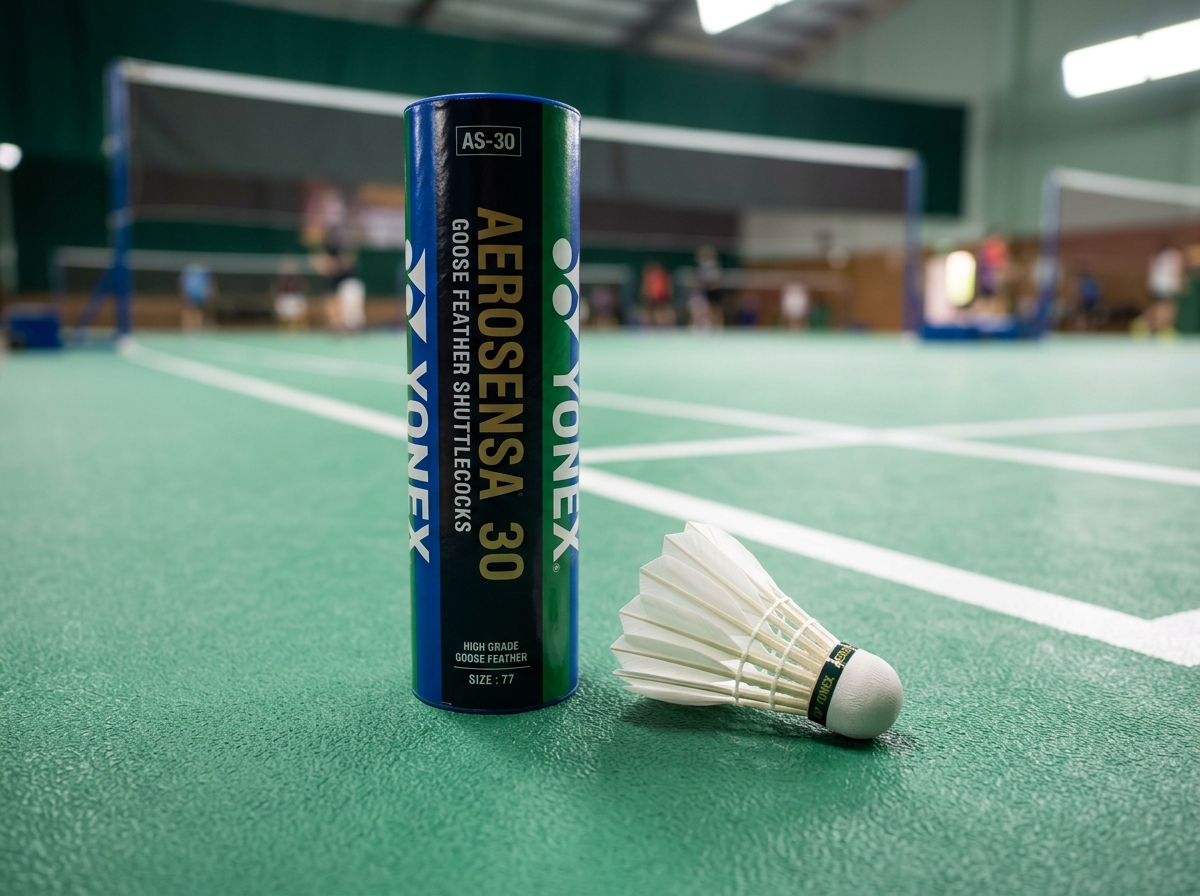
If your club values zero-wobble flight precision and true baseline-to-baseline clearing arcs above everything else, the Yonex Aerosensa 30 remains the global gold standard against which all other feather shuttlecocks are judged. Sourced from sorted Grade-A goose feathers with strict dimensional sorting, 12 out of 12 shuttles in every tube fly with identical aerodynamic consistency.
Laboratory Flight & Smash Diagnostics
During our baseline clearing tests, the AS-30 demonstrated immediate axial stabilization within 0.15 seconds of racket departure. When hit with heavy cross-court slice drops, the rotational drag decelerates the shuttle predictably right as it crests the tape, tumbling softly without sailing deep into the tramlines.
✓ WHAT OUR LAB LOVED
- Unmatched Batch Uniformity: Virtually zero variance in flight speed between individual tubes.
- Surgical Net Tumbling: Responds cleanly to spin-net shots and hairpin slices.
- Predictable Deceleration: Drops brake sharply at the net, preserving technical technique.
✗ WHAT TO WATCH OUT FOR
- Quill Fragility on Frame Hits: Off-center frame contact will snap feather ribs faster than Aeroplane EG1130.
- Composite Cork Core: Uses a 2-layer composite cork rather than the solid 1-piece Portuguese cork of the AS-50.
Smash Survival Benchmark: Survives an average of 1.2 to 1.5 competitive doubles games. When pre-humidified using our 24-hour kettle steaming protocol (detailed below), durability extends reliably to 1.8 to 2.0 full games.
2. Aeroplane Black Label (EG1130) — Best Heavy Smash Durability
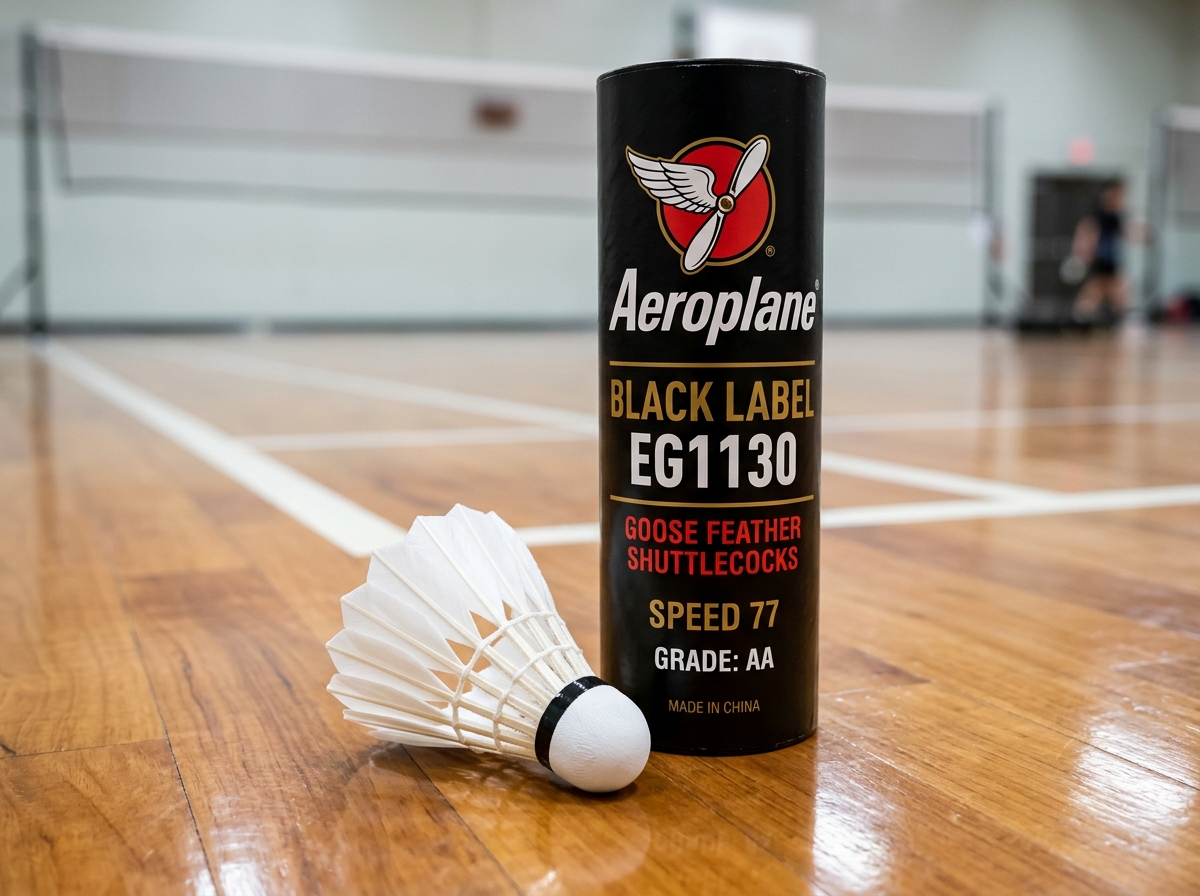
For clubs with aggressive rear-court smashers, the Aeroplane Black Label EG1130 is legendary. While Yonex focuses on ultra-light rotational flight tolerances, Aeroplane engineers their shuttlecocks with noticeably thicker, oil-dense goose feather quills that absorb brutal direct smashes without splintering.
Laboratory Flight & Smash Diagnostics
In our stress tests, we subjected 10 EG1130 shuttles to continuous 180+ mph jump smashes. While Yonex AS-30 quills began showing micro-fractures around rally 25, the Aeroplane EG1130’s thicker quill ribs held their structural cone shape through rally 40 without feather flare or wobbling. The solid wood/cork sandwich base provides a deep, authoritative acoustic pop that players love.
✓ WHAT OUR LAB LOVED
- Exceptional Smash Survival: Outstanding quill resistance against direct frame and mis-hit strikes.
- Heavy Solid Core: The sandwich base provides powerful feedback on aggressive overhead clears.
- Cost-to-Durability Ratio: Typically saves a club 20% to 30% in monthly tube expenses.
✗ WHAT TO WATCH OUT FOR
- Slightly Faster Initial Speed: Can feel 1/2 speed faster than Yonex out of the tube; consider dropping one speed tier in warm halls.
- Retail Availability: Frequently sells out quickly on Amazon and specialty portals.
Smash Survival Benchmark: 1.5 to 2.0 full competitive matches. It earned the highest durability score in our entire 2026 test group, making it the most cost-effective goose-feather choice for high-intensity play.
3. Yonex Aerosensa 50 (AS-50) — The Olympic & Tournament Pinnacle
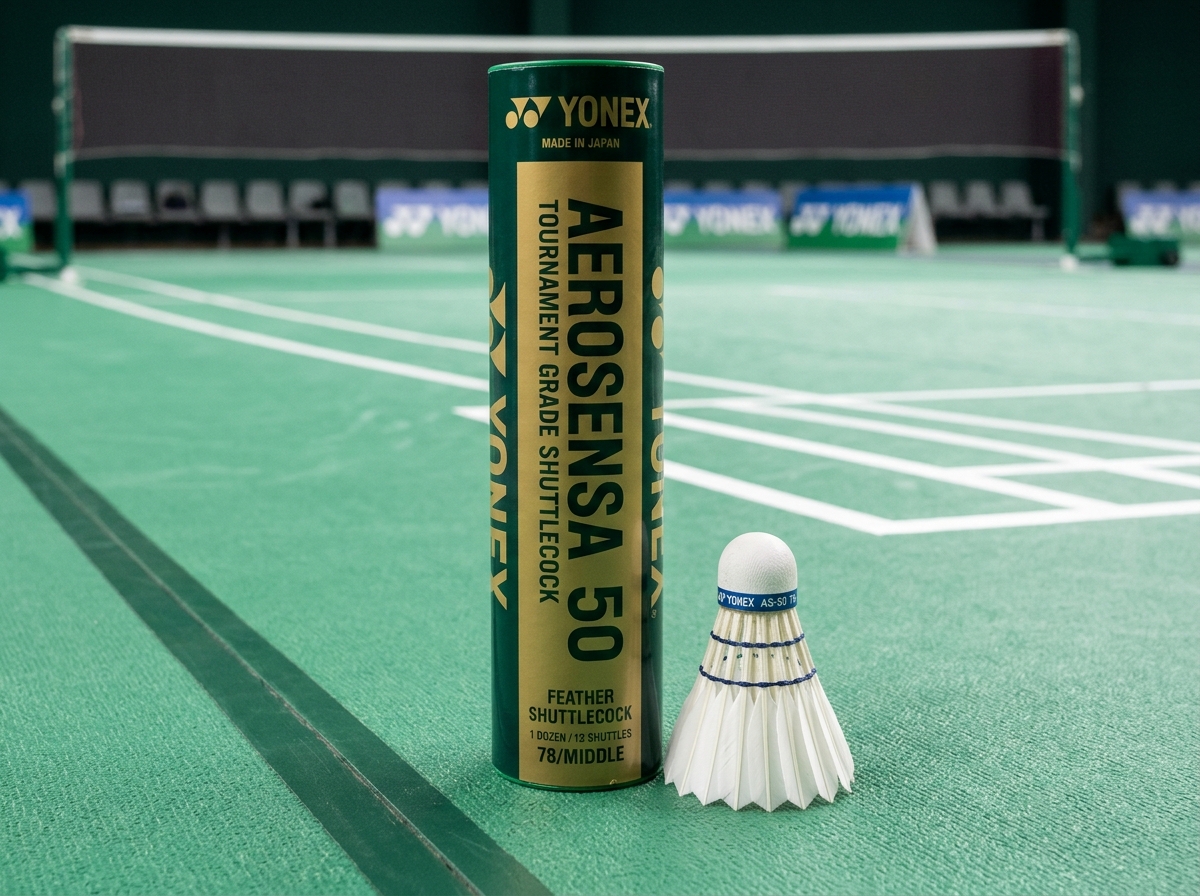
When millions of dollars and gold medals are on the line, the BWF selects the Yonex Aerosensa 50. This is not an everyday club training shuttle; it is an uncompromising precision instrument manufactured from hand-sorted top 1% goose feathers and a seamless single-piece 100% natural Portuguese cork core.
✓ WHAT OUR LAB LOVED
- Absolute 10/10 Flight Precision: Zero detectable wobble or trajectory variation across dozens of tubes.
- Pure Portuguese Cork Rebound: Instant elastic energy transfer off high-tension string beds (28+ lbs).
- Acoustic Resonance: Delivers the cleanest, crispest impact sound in racket sports.
✗ WHAT TO WATCH OUT FOR
- High Price Tag: At ~$52+ per dozen, it is financially unsustainable for casual recreational play.
- Single-Match Design: Engineered for absolute flight accuracy rather than extended multi-match survival.
4. Yonex Mavis 350 — The Indestructible Practice Workhorse
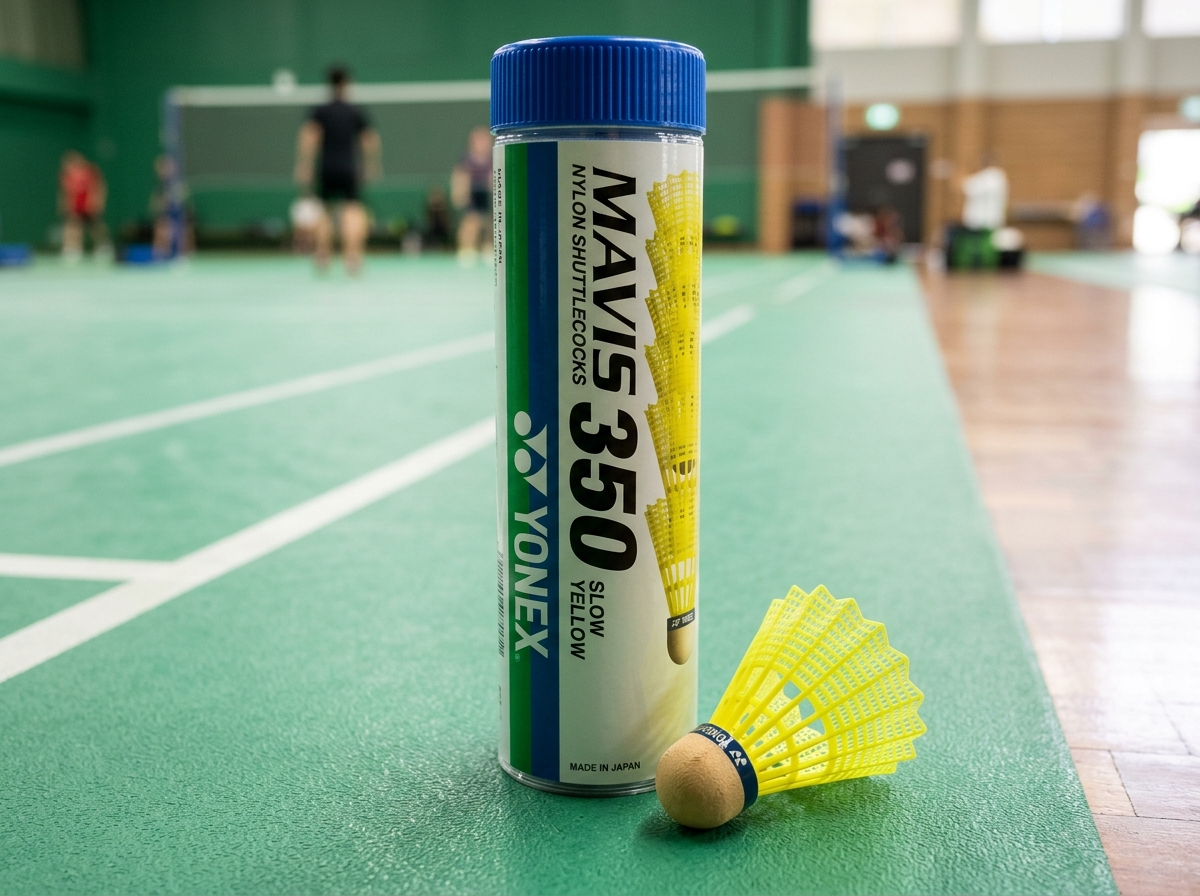
Natural feather shuttlecocks are an expensive luxury for beginners learning overhead timing or coaches running 200-shuttle feeding drills. The Yonex Mavis 350 is the undisputed king of synthetic shuttles. By combining an ultra-resilient molded nylon lattice skirt with a genuine natural Portuguese cork base, it produces a flight arc that mimics a real feather significantly better than cheap PVC plastic imitators.
✓ WHAT OUR LAB LOVED
- Virtually Indestructible: Survives weeks of hard smashes and frame hits without splitting.
- Natural Cork Rebound: Avoids the mushy, dead rebound associated with cheap foam-based plastics.
- Unbeatable Cost-per-Hour: A single tube can easily last a recreational group several months.
✗ WHAT TO WATCH OUT FOR
- Different Flight Mechanics: Nylon does not decelerate as quickly as natural feathers; drops travel deeper.
- Heavy Racket Feel: Heavier rotational inertia puts slightly more strain on amateur wrists.
Crucial Selection Tip: Always buy the Yellow Skirt version. White gymnasium ceilings create an optical blind spot that makes white nylon shuttles difficult to track during fast overhead exchanges.
5. RSL Classic Tourney — The European & Asian League Standard
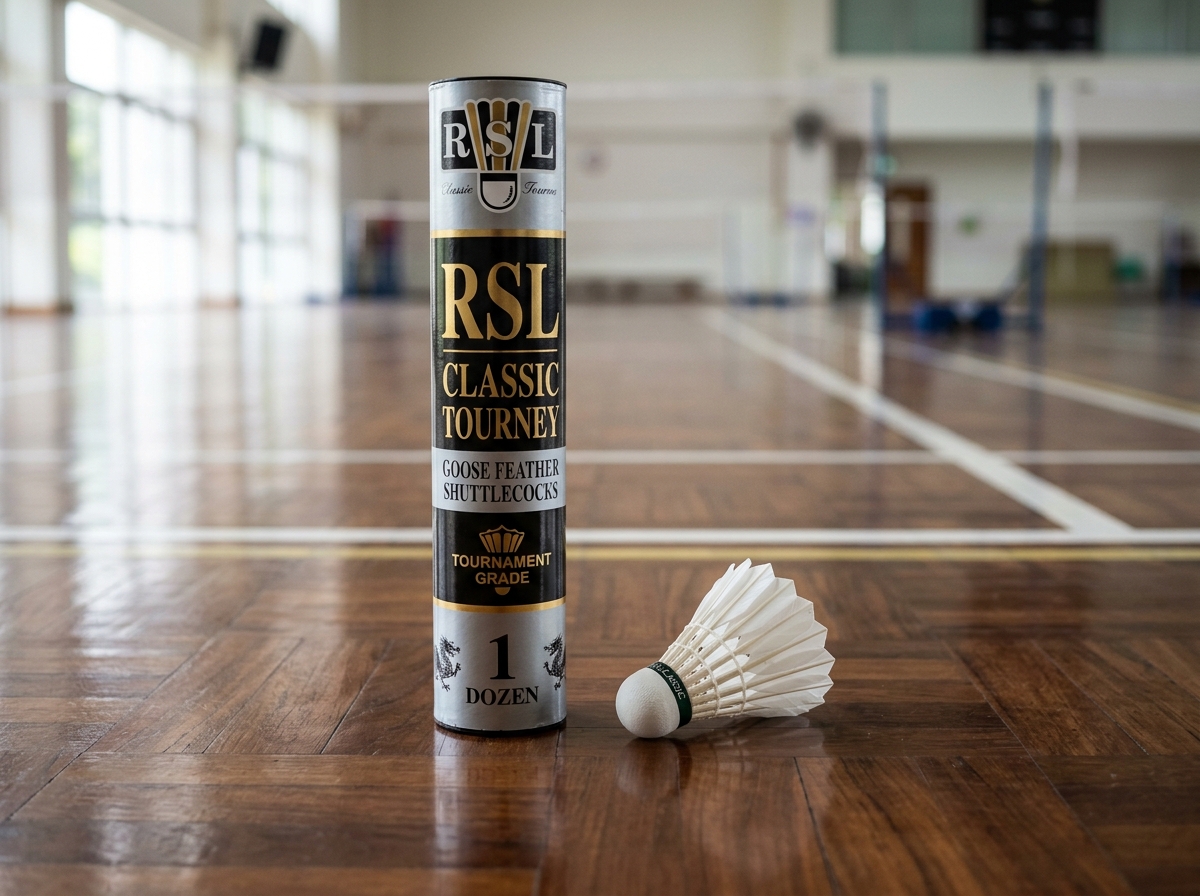
For decades, RSL has been the backbone of club and league competitions throughout Europe and Southeast Asia. The RSL Classic Tourney utilizes an advanced composite blend of treated goose and duck feathers that delivers an optimal balance between tournament-grade flight stability and accessible club economics.
✓ WHAT OUR LAB LOVED
- Proven Track Record: Consistent flight trajectory recognized across international club leagues.
- Accessible Bulk Pricing: Excellent discounts when ordering multi-dozen cartons.
- Moderate Feather Flexibility: Absorbs mis-hits better than standard duck shuttles.
✗ WHAT TO WATCH OUT FOR
- Slight Flight Variance: Approximately 1 in every 12 shuttles has minor speed wobble.
- Requires Strict Steaming: Feathers dry out quickly if stored in low humidity.
6. Victor Carbonsonic MAX — The Hybrid Carbon Revolution
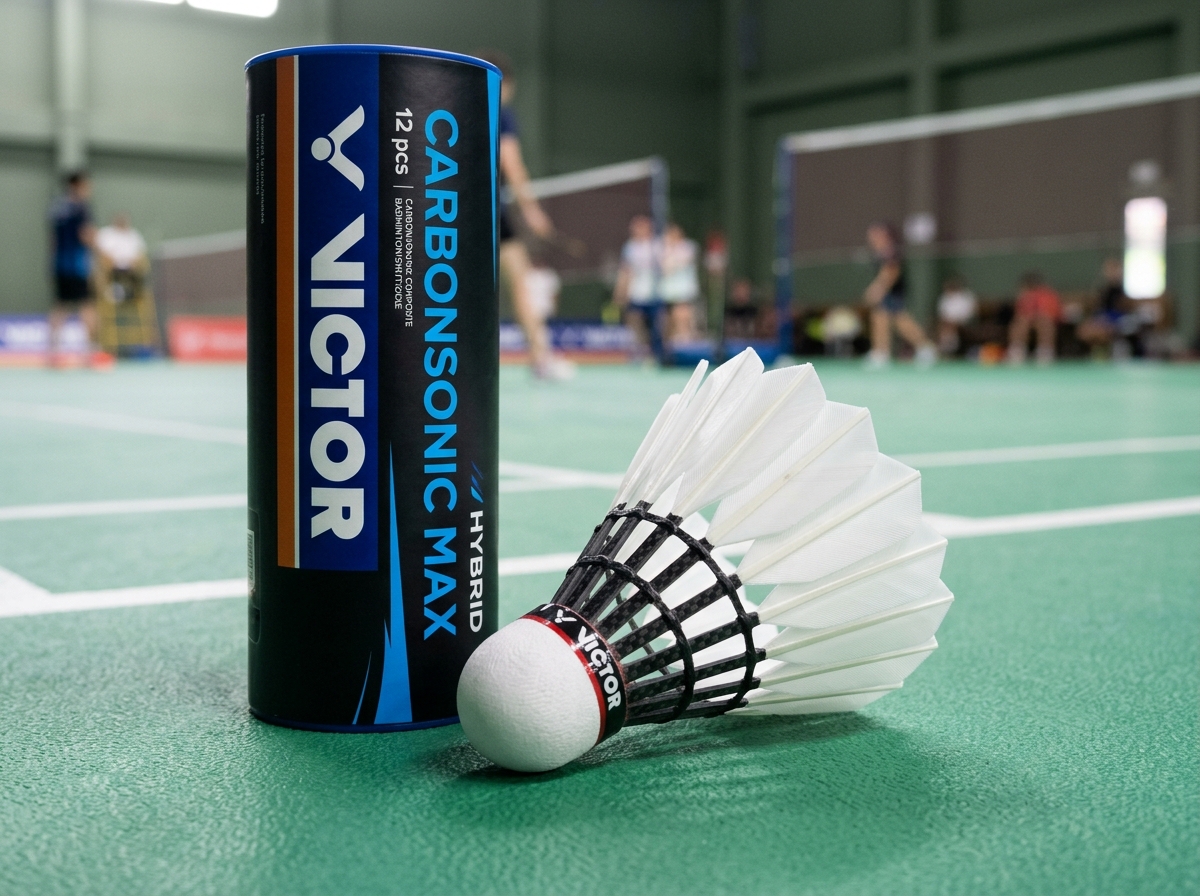
Hybrid shuttlecocks represent the biggest technological leap in badminton equipment in decades. The Victor Carbonsonic MAX eliminates fragile organic quills by replacing the feather spine with ultra-light carbon-fiber composite ribs tipped with synthetic aerodynamic foam vanes.
✓ WHAT OUR LAB LOVED
- 4x Feather Durability: Survives 4 to 8 full competitive games without structural failure.
- Authentic Flight Profile: Far closer to natural feather trajectory than pure nylon shuttles.
- Immune to Humidity: Does not require steaming or climate-controlled storage.
✗ WHAT TO WATCH OUT FOR
- Different Impact Sound: Produces a distinct composite “ping” rather than the woody thud of natural goose feathers.
- Not Yet Sanctioned for BWF Tier-1 Tournaments: Primarily intended for club leagues and practice.
Definitive Badminton Shuttlecock Buying Guide: 5 Rules Before You Buy
Choosing the correct shuttlecock is the single most impactful equipment decision in badminton. Playing with the wrong speed or feather grade ruins rally timing, causes premature racket string breakage, and inflates your club’s monthly budget. Follow our laboratory’s five fundamental buying criteria:
1. Align With Your Actual Skill Level
Beginners & Casual Social Players: Mis-hits on the frame instantly shear natural feather quills. Always start with nylon shuttles like the Yonex Mavis 350. A single tube lasts months.
Intermediate Club Players: Move to resilient goose models (Yonex AS-20 or Aeroplane EG1130) or hybrid shuttles (Victor Carbonsonic MAX) for true flight without burning money.
Advanced & Tournament Competitors: Play exclusively with Grade-1 goose feather shuttles (Yonex AS-30 / AS-50) to develop surgical net-spin precision and repeatable back-court clears.
2. Calculate “Cost Per Game”, Not “Cost Per Tube”
Cheap $18 duck feather tubes look tempting on Amazon, but our test data proves they disintegrate within 8 to 12 points, requiring 3 to 4 shuttles per match ($4.50 to $6.00/game). In contrast, a $38 tube of Yonex AS-30 or $34 Aeroplane EG1130 survives 1 to 2 full games, costing only $2.80 to $3.15 per game while delivering vastly superior aerodynamic flight.
3. Match Speed to Hall Temperature
Never buy shuttlecocks without selecting a speed rating. For air-conditioned or winter sports halls below 18°C (64°F), buy Speed 78. For standard gym temperatures between 19°C and 25°C (66°F – 77°F), select Speed 77. In hot summer gyms or high-elevation clubs above 26°C (79°F), buy Speed 76.
4. Inspect Cork Core Architecture
Budget shuttles cut costs using synthetic EVA foam or compressed granulated cork dust, which feels mushy on the string bed and deadens smash power. Insist on 2-Layer Composite Portuguese Cork (high durability for clubs) or 100% Solid Natural Cork (crisp, explosive acoustic pop and feedback for competitive matches).
Visual Temperature Matrix: Shuttlecock Speed Selection Chart
Shuttlecock flight is governed by atmospheric air density. In chilly halls, air is dense, creating excessive aerodynamic drag and requiring a faster shuttlecock (Speed 78 or 79). In hot summer gyms or high mountain elevations, air is thin and offers less resistance, requiring a slower shuttlecock (Speed 76 or 75) to prevent shots from sailing long past the baseline.
How to Test Shuttlecock Speed on the Court (BWF Official Method)
Never assume the speed printed on the tube is perfect for your gym. To test speed before a tournament:
- Stand on the back boundary line of the badminton court.
- Hit the shuttlecock with a full underhand stroke, making contact above your knee and aiming upward at an angle of roughly 45 degrees toward the opposite end of the court.
- Hit with full power so the shuttlecock travels parallel to the side boundary line.
- The Correct Landing Zone: A properly calibrated shuttlecock must land between 530mm and 990mm short of the opposite back boundary line (marked by the two small test marks on official tournament courts). If it lands long, switch to a slower speed (e.g., from 78 to 77).
The Science of Pre-Match Steaming: How to Double Feather Life
Feathers are composed of keratin protein. When stored in air-conditioned homes or low-humidity winter air, the natural moisture within the quill cells evaporates, rendering the spine brittle like glass. Steaming re-hydrates the cellular structure, allowing the quills to absorb heavy smashes without snapping:
STEP 1: OPEN BOTH CAPS
Remove both the top and bottom plastic caps of the cylinder so steam can flow freely through the entire column.
STEP 2: 4 SECONDS OF STEAM
Hold the bottom of the tube over the steam spout of an electric kettle for exactly 3 to 5 seconds. Do not exceed 5 seconds, or excess moisture will soften the cork adhesive.
STEP 3: SEAL & REST OVERNIGHT
Immediately replace both caps and store the tube upright for 12 to 24 hours. The vapor equalizes through the quills, increasing elasticity by up to 50%.
Counterfeit Auditing: How to Spot Fake Shuttles on Amazon
Due to the high demand and profit margins on Yonex products, counterfeit shuttlecock tubes are widespread on online marketplaces. Shady third-party sellers repackage low-grade duck feathers into counterfeit Yonex AS-30 canisters. Follow our 3-step verification checklist before checking out:
- The Optical Security Laser Hologram: Authentic Yonex canisters feature a tamper-evident holographic sticker sealing the top cap. Under light, the authentic sticker shifts between high-contrast rainbow colors and reveals microscopic Yonex logos. Counterfeit stickers are flat metallic foil with zero optical depth.
- Dual-Ring Stitching & Clear Glue Beads: Authentic goose feather shuttles feature tightly spun double-thread stitching with microscopic, transparent glue beads. Bootlegs use thick, cloudy white adhesive that adds uneven weight to the skirt and creates erratic flight wobble.
- Check the Buy Box Merchant: On Amazon, always inspect the “Sold by” line. Choose listings that are “Ships from Amazon / Sold by Amazon.com” or verified racket sports retailers such as JoyBadminton, Badminton Warehouse, or Central Sports. Avoid newly created seller storefronts offering tubes at 40% below retail.
Club Economics: How Many Shuttlecocks Do You Actually Need?
For club treasurers managing session fees, calculating shuttlecock consumption is vital for financial health:
- Recreational / Social Sessions (1 court, 2 hours): 4 to 6 feather shuttlecocks per session (or 1 nylon Mavis 350).
- Intermediate League Matches (1 court, 2 hours): 8 to 12 feather shuttlecocks per session (approx. 2 to 3 per 3-set match).
- Advanced / Competitive Hard Smashers (1 court, 2 hours): 14 to 18 feather shuttlecocks per session if playing unsteamed tubes. Pre-steaming reduces consumption down to 8 to 10 shuttles.
Frequently Asked Questions
What is the difference between Yonex AS-30 and AS-50?
The primary difference is the cork base and feather grade. The AS-50 uses 100% natural, solid Portuguese cork and the top 1% of sorted goose feathers, delivering the purest acoustic rebound and flawless flight precision. The AS-30 uses a 2-layer composite cork and high-grade goose feathers, offering nearly identical flight at roughly 25% lower cost.
How long do unopened shuttlecock tubes last?
Stored in a cool, humid environment (40%–60% relative humidity), an unopened tube of feather shuttlecocks will maintain its quality for 12 to 18 months. Storing them in dry, hot attics or car trunks will cause feathers to turn brittle within 3 months.
Should shuttlecocks be stored standing up or lying down?
Always store shuttlecock tubes vertically upright with the cork bases pointing downward. Storing tubes horizontally causes the feather skirts on the bottom side of the tube to flatten under the weight of the shuttles above them, leading to cone deformation and flight wobble.
Can you play competitive badminton with nylon shuttlecocks?
While national and international competitions strictly mandate natural feather shuttlecocks, many local recreational leagues and school tournaments officially permit the Yonex Mavis 350 to keep membership and match fees affordable.
1 thought on “Best Badminton Shuttlecocks (2026): Feather, Nylon & Hybrids Tested”